
Industrial glass coating with maximum process reliability
Uniform coating, high adhesion, and stable processes are crucial for cost-effective industrial glass coating. Dürr supports glass manufacturers with tailored solutions combining application technology, paint supply, control technology, and process expertise.
Whether decorative edge coatings, functional glass coatings, or large-area coating applications: Dürr enables precise and reproducible results—even for demanding applications using water-based coating systems.
Benefits at a glance
- High coating quality on glass surfaces
- Reduced paint consumption thanks to high application efficiency
- Stable production processes with high reproducibility
- Flexible automation for existing and new production lines
- Solutions for transparent, opaque, and functional coatings
Please contact us:
Challenges in glass coating
Industrial glass coating is one of the most demanding coating processes. Unlike metallic materials, glass is not electrically conductive and places high demands on adhesion, wetting, and process control. With water-based coatings in particular, numerous factors must be precisely coordinated:
- Wetting behavior on smooth glass surfaces
- Uniform film thicknesses
- Coating adhesion
- Airflow and drying conditions
- Stability in mass production
Even minor process deviations can lead to quality issues, increased scrap, or unnecessary material consumption. Therefore, precise application technologies and reliable process control are crucial in glass coating.
Solutions for industrial glass coating
In glass coating, application technology, paint supply, and process control are closely interlinked. Dürr offers a coordinated portfolio for automated glass coating and supports glass manufacturers in implementing efficient, reproducible, and cost-effective coating processes.

Precise glass coating without masking
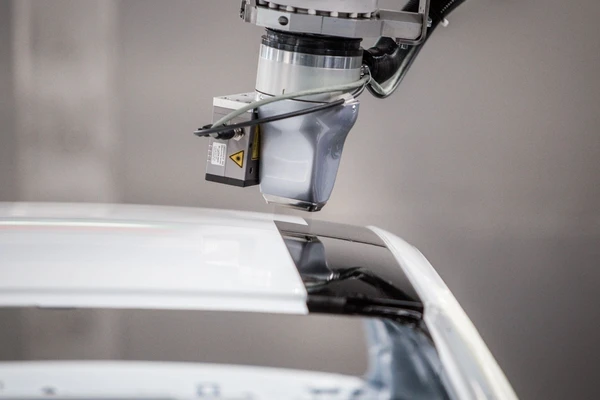
With the EcoPaintJet, coatings can be applied precisely and without overspray to glass. Edge coatings, privacy strips, or decorative contours are digitally programmed and applied without stencils or masking. The technology achieves application efficiency of up to 100% and significantly reduces material consumption and process costs.

Cost-effective coating of glass surfaces
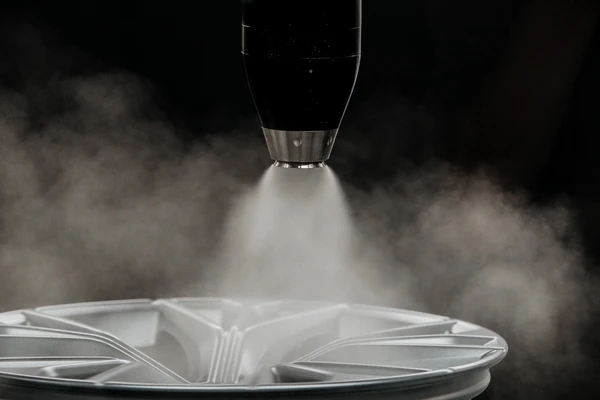
The EcoBell2 high-rotation atomizer ensures a uniform coating on glass surfaces while delivering high application efficiency of up to 90% and reduced paint consumption. Thanks to high paint flow rates, optimized atomization, and fast color changes, both transparent and opaque coating can be applied cost-effectively. The technology is designed for automated production lines and can be flexibly integrated into new or existing systems.

Compact paint supply system for flexible glass coating
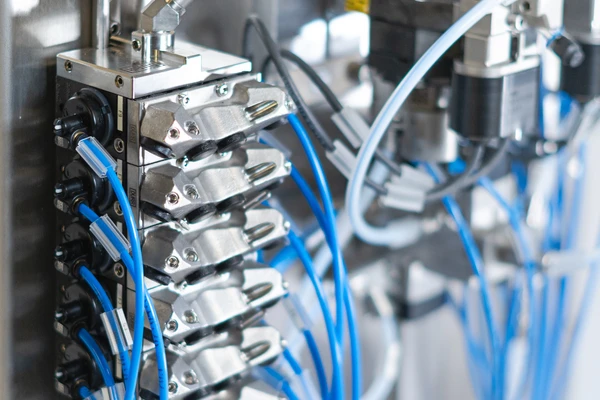
The Fluid Board combines the control system and applicator into a preconfigured unit for paint supply. The modular system supports common 1K and 2K coating processes and can supply up to ten colors. The pre-assembled plug-and-play solution significantly reduces engineering, installation, and commissioning efforts. For glass manufacturers, this means rapid integration of new coating processes while ensuring high process reliability.

Intelligent process control for maximum flexibility
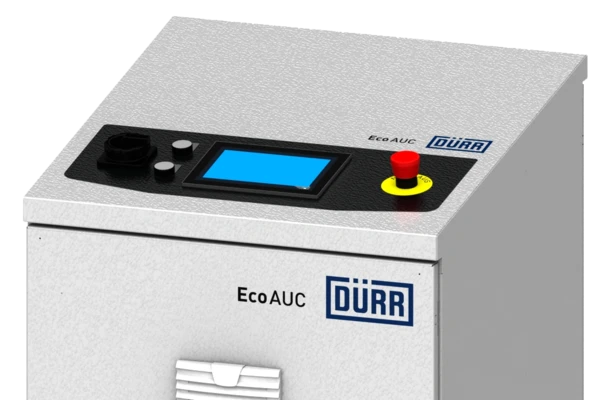
The EcoAUC2 serves as the central control system for the paint booth. It coordinates applicators, paint supply, and cleaning systems, and enables the control of up to 20 paint colors and up to five hardener components. Modern interfaces facilitate easy integration into existing production environments.
Thanks to the ready2integrate concept, glass manufacturers benefit from short startup times, high process reliability, and maximum flexibility when switching products and meeting individual customer requirements.

Reference: Glass coating for the commercial refrigeration industry
For the glass processor PAN-DUR, Dürr implemented the use of EcoPaintJet technology for the first time to coat insulated glass units for commercial refrigeration units. The goal was to apply opaque edge coatings directly to the glass, thereby replacing the previous screen printing process. Thanks to the precise, overspray-free coating application, stencils, screens, and time-consuming masking procedures were eliminated. Today, the contours are programmed digitally and can be adapted immediately to new designs or glass formats. This significantly increases flexibility while reducing storage costs for screens and setup times.
The result is a cost-effective, scalable, and future-proof coating process for industrial glass manufacturing.
FAQ
Glass is non-conductive, has a transparent surface, and is sensitive to process fluctuations. Therefore, adhesion, wetting, airflow, and application parameters must be precisely coordinated.
Water-based coating systems place high demands on wetting, drying, process stability, and material flow. To make reliable statements about coating properties, approval from the coating or process manager is required.
The original content mentions humidity, air velocity, precise control, bell-dish rinsing, and directed airflow.
Any questions?
Contact us!

Carl-Benz-Str. 34
74321 Bietigheim-Bissingen
Niemcy